Search News
Hot Articles
What Causes Starch Gelatinization Failure in Extruded Snacks?
Time
Click Count
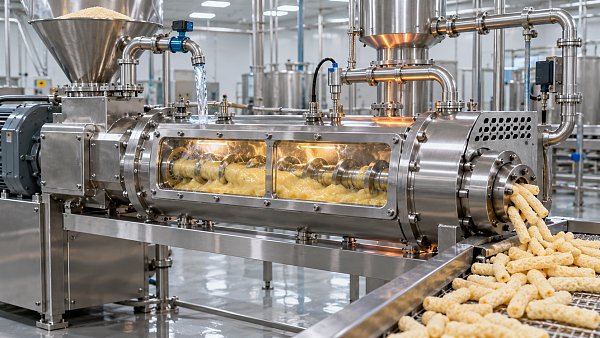
A snack line can appear stable at the die, yet produce pieces that are dense, hard, weakly expanded, or inconsistent from one production interval to the next. In many of these situations, the underlying problem is incomplete or poorly controlled starch gelatinization. The starch has not absorbed enough water, heat, and mechanical energy to form the melt structure needed for expansion when pressure drops at the die.
The short answer to what causes starch gelatinization failure in extruded snack production is that the moisture–temperature–shear balance is wrong for the specific formulation. Low or poorly distributed water, unsuitable starch sources, incorrect barrel temperature zoning, unstable feed, poor screw design, excessive fat, and inadequate residence time can each prevent starch granules from transforming properly. The practical task is not simply to raise temperature or add water; it is to identify which part of the extrusion system is limiting starch conversion.
What gelatinization should achieve inside the extruder
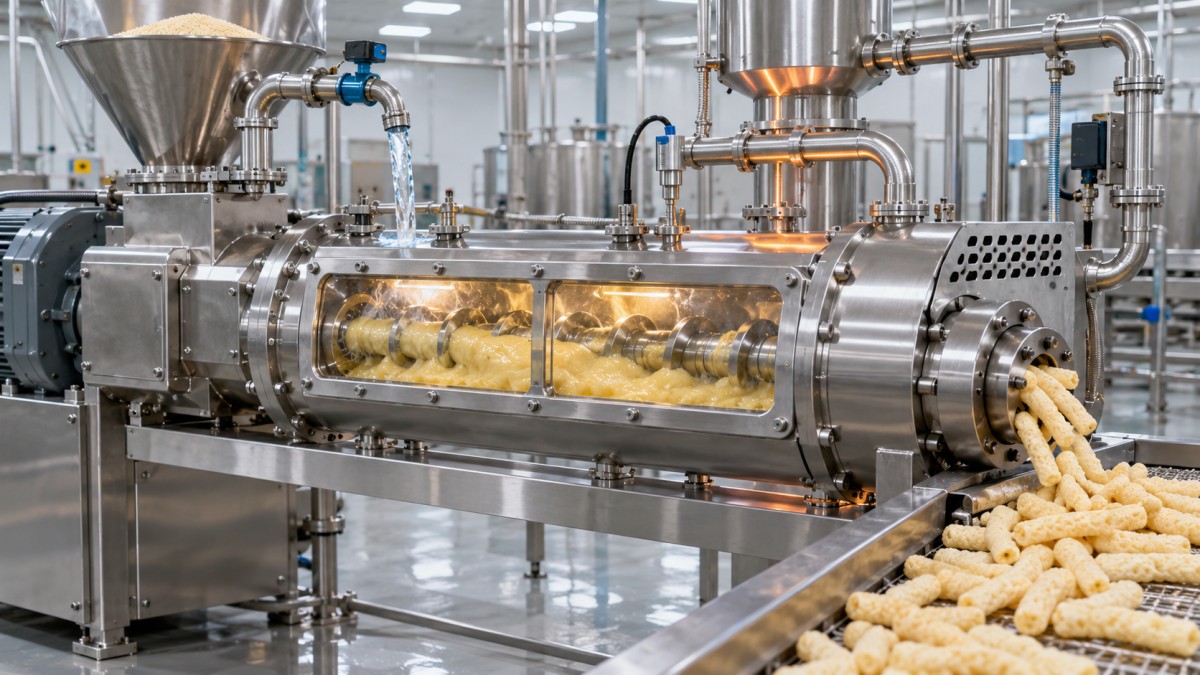
Starch gelatinization begins when starch granules take up water and are heated sufficiently to lose their organized crystalline structure. In an extruder, this process is intensified by pressure and shear. As the material moves through the barrel, water hydrates the starch while heat and mechanical energy disrupt the granules and create a viscous, continuous dough or melt.
For directly expanded snacks, the material must leave the die in a condition that can retain internally generated steam long enough to form a cellular structure. When pressure is released, water flashes into vapor and expands the product. A properly gelatinized starch matrix stretches around those gas cells, helping create a light, crisp texture. A weak or incompletely cooked matrix may not expand sufficiently, may collapse after exiting the die, or may produce a coarse, uneven internal structure.
Gelatinization is not always an all-or-nothing event. A line may produce acceptable snacks during one shift and poor expansion during another because the degree of cooking has drifted. That is why operators should evaluate both obvious failure and gradual quality loss.
Symptoms that point to inadequate starch conversion
Low expansion is the most familiar warning sign, but it is not the only one. A product can expand reasonably well while still having poor crunch, uneven cell structure, or an undesirable hard bite. Looking at several symptoms together provides a better diagnosis than relying on piece diameter alone.
- Dense or compact pieces: insufficient expansion after the die, often accompanied by higher bulk density.
- Hard, glassy, or tough texture: the starch matrix may be undercooked, poorly hydrated, or overly compressed.
- Uneven expansion: alternating large and small pieces can indicate feed fluctuations, moisture variation, or unstable pressure.
- Surface cracks or collapsed cells: the melt may lack enough integrity at the die, or moisture release may be poorly controlled.
- Visible raw specks or sandy mouthfeel: coarse particles or incompletely hydrated starch-containing ingredients may not have received enough thermal and mechanical treatment.
- High motor load with disappointing expansion: this can signal excessive viscosity, poor water distribution, restrictive flow, or a screw profile that is generating resistance without achieving uniform cooking.
These symptoms can also result from die design, post-drying conditions, or formulation changes. The useful question is whether the issue begins with the melt leaving the die or develops later. If pieces are already dense and irregular at discharge, the primary investigation should focus on the extrusion process rather than seasoning or drying.
Water may be present, but not available where starch needs it
Low feed moisture is a direct cause of gelatinization failure because starch requires water to swell and reorganize. However, total moisture on a formulation sheet does not always represent the water available to the starch fraction. Water can be tied up by fiber, protein, sugars, hydrocolloids, salt, or pregelatinized powders. A formula with the same measured moisture can behave very differently after an ingredient substitution.
Poor distribution is equally important. When water is added only at one point and mixing is weak, parts of the feed may enter the cooking zone too dry while other areas form wet agglomerates. The result can be alternating pressure, uneven torque, and variable expansion. Dry pockets may remain partially ungelatinized even when average barrel conditions appear correct.
Where to look first when moisture is suspected
Confirm the actual moisture of incoming meals, grits, flour blends, and rework rather than assuming supplier specifications are unchanged. Hygroscopic materials can gain or lose moisture during storage, especially after bags are opened or when ambient humidity changes. Check feeder accuracy, water flow calibration, injection location, and preconditioning time. If the system uses steam in a preconditioner, verify that condensate or poor mixing is not creating local wet zones rather than uniform hydration.
Raising water indiscriminately is not always the answer. More water can reduce melt viscosity and mechanical energy input. In some formulations, that may improve hydration but reduce the shear required for complete transformation. Adjustments should be made while observing die pressure, specific mechanical energy, motor load, product density, and final texture together.
Barrel temperatures can be correct on the screen and wrong in the product
Extruder setpoints are control targets, not direct proof of product temperature or cooking quality. Heat transfer depends on barrel fill, screw speed, material flow, friction, water content, and the condition of heating and cooling systems. A zone can display its target temperature while the material passing through it experiences insufficient residence time, uneven heating, or excessive cooling.
Insufficient temperature in the compression and cooking sections commonly leaves starch partly intact. Yet excessive heat can also create problems. If heat is applied too early to a poorly hydrated blend, the surface of particles may become sticky while the center remains under-hydrated. Very high thermal input can degrade the starch matrix, darken sensitive ingredients, promote sticking, or lead to unstable viscosity at the die.
A better approach is to view the barrel as a thermal profile rather than a collection of isolated temperatures. Early zones should support hydration and conveyance. Later zones should provide enough thermal and mechanical work to create a homogeneous melt. The final zone and die region must maintain a stable condition that supports controlled flashing. The optimum profile depends on the starch source, particle size, inclusion level, desired shape, and moisture target.
Raw material variability is often mistaken for an equipment problem
Different starch-bearing ingredients gelatinize differently. Corn grits, rice flour, potato starch, tapioca starch, wheat-based ingredients, pulse flours, and modified starches do not respond identically to water, heat, and shear. Their granule structure, amylose-to-amylopectin balance, damaged starch level, particle size, protein content, fiber content, and lipid content all influence extrusion behavior.
A change in granulation can be especially disruptive. Coarser particles may need more time to hydrate and cook. Very fine material may absorb water rapidly, compact more easily, and alter barrel fill or shear. A blend that contains more whole-grain material, bran, legume flour, or botanical powder can require a different moisture profile and screw configuration than a mostly refined cereal base.
Ingredient approval should therefore include processing behavior, not only nutritional or sensory specifications. When a quality problem follows a new lot, supplier change, seasonal crop shift, or reformulation, compare the incoming material profile before changing multiple machine settings.
Screw configuration determines whether the material receives useful work
A twin-screw extruder can generate very different conditions depending on screw elements, pitch, kneading block arrangement, reverse elements, fill level, and speed. A configuration designed for gentle conveying may move material through the barrel with limited mixing and insufficient shear. One designed too aggressively may create high torque, excessive frictional heating, or unnecessary degradation.
Starch gelatinization failure can occur when the screw profile does not provide enough distributive mixing to spread water evenly, enough dispersive mixing to break down agglomerates, or enough residence time in the cooking region. This is particularly relevant after a formula becomes more complex. Added protein, fiber, sugar, inclusions, or fat can change melt behavior enough that a profile optimized for a simple corn snack is no longer suitable.
Before changing screw elements, review operating evidence. Stable low torque and low die pressure may suggest the material is passing through with too little work. High and fluctuating torque may point to poor hydration, overfilling, restrictions, or inconsistent feeding. The same low expansion outcome can arise from either condition, so machine load data must be interpreted alongside moisture and product observations.
Feed instability creates a moving gelatinization target
Even a well-designed process cannot cook a material consistently when the feed rate changes continuously. Loss-in-weight feeders that bridge, pulse, or drift will alter barrel fill and residence time. A temporary reduction in feed can expose material to more heat and shear; a surge can shorten residence time and leave it undercooked. Water addition that does not track dry feed accurately creates the same problem.
Watch for a repeating relationship between feeder behavior, torque, die pressure, cutter load, and product density. The timing may be delayed because material takes time to travel through the barrel. This delay often leads teams to adjust the wrong variable, such as changing die temperature when the initiating problem occurred upstream at the feeder.
Rework can also destabilize feeding. Its moisture, particle size, oil content, and degree of pre-cooking differ from fresh raw material. Adding it in an uncontrolled proportion can change the water demand and melt structure from minute to minute. Establishing a defined rework condition and controlled addition rate is more reliable than treating it as a harmless dry ingredient.
Fat, sugar, and other inclusions can shift the process window
Fat may lubricate particles and reduce frictional heating. At moderate levels it can be useful for certain textures, but excessive or poorly timed addition can reduce shear and hinder starch hydration. Surface oil on raw materials may also coat particles before water has penetrated effectively.
Sugars, salts, proteins, and soluble solids affect water activity and melt viscosity. High-sugar systems can become sticky and may require different thermal control. Protein-rich snacks often expand less readily than starch-dominant products because protein changes the structure of the melt and competes for moisture. Insoluble fibers and particulate inclusions can interrupt bubble growth and create fracture points in the expanding product.
These ingredients do not automatically cause failure. They narrow the processing window. A formulation change should be evaluated through a controlled trial that tracks moisture, throughput, barrel profile, screw speed, die pressure, expansion, and texture rather than changing every setpoint at once.
A practical way to isolate the root cause
When product quality falls, begin with the most recent change: raw material lot, formulation, feeder setting, water source, screw speed, die condition, throughput, or maintenance activity. Then return the process to a known stable operating condition where possible. This prevents several interacting adjustments from obscuring the cause.
- Check the product at die exit. Record expansion appearance, surface condition, temperature, and whether the issue is continuous or intermittent.
- Verify actual inputs. Measure feed moisture, dry feed rate, liquid or steam addition, and rework proportion. Confirm instruments are reading and dosing correctly.
- Review process trends. Compare torque, pressure, barrel temperatures, screw speed, and throughput before and during the quality shift.
- Inspect material preparation. Look for segregation, bridging, agglomerates, irregular grind, or insufficient preconditioning.
- Make one deliberate adjustment. Change a single relevant variable, allow the system to stabilize, and evaluate the product before making another change.
Die restrictions, worn screws, damaged barrel liners, blocked vents, or inaccurate temperature sensors should also be considered when the process no longer responds as expected. Mechanical wear can reduce the actual mixing and pressure development available to cook the product, even though the line is operating at familiar settings.
Questions that arise during troubleshooting
Can low expansion occur even when starch is fully gelatinized?
Yes. Full or near-full gelatinization does not guarantee high expansion. Die geometry, melt moisture, viscosity, pressure stability, formulation solids, and post-die drying can still limit expansion. Gelatinization is a major condition for a good expanded structure, but it is not the only one.
Does increasing screw speed always improve gelatinization?
No. Higher screw speed can raise shear and mechanical energy, but it can also reduce residence time. Whether it improves cooking depends on barrel fill, moisture, screw design, and thermal input. Evaluate the change through both process signals and finished product texture.
Why does the product fail only after a raw material change?
The new material may have different initial moisture, particle size, starch characteristics, fiber level, protein level, or fat content. Even a specification-compliant ingredient can behave differently in extrusion. Compare the lot against the previous material and adjust the process based on its actual functional properties.
When is laboratory analysis useful?
Laboratory assessment is useful when line observations cannot distinguish between raw-material variability and process failure. Moisture testing, particle-size review, starch damage assessment, and examination of product structure can help narrow the issue. It is especially valuable when recurring defects persist despite verified feeder, water, and temperature control.
News Recommendations
 What Membrane Pore Size Is Needed to Concentrate Fruit Juice?
![51a6ab95581761cc26f4318be6520c15]()
Aris Katos
Future of Carbide Coatings
 Can Guar Gum Replace Agar Agar in Plant-Based Puddings and Gels?
![51a6ab95581761cc26f4318be6520c15]()
Aris Katos
Future of Carbide Coatings
 Is guar or xanthan gum more suitable for acidic salad dressings?
![51a6ab95581761cc26f4318be6520c15]()
Aris Katos
Future of Carbide Coatings
 Should you use xanthan gum or guar gum in gluten-free bread?
![51a6ab95581761cc26f4318be6520c15]()
Aris Katos
Future of Carbide Coatings
 Can guar gum and xanthan gum reduce ice crystals in ice cream?
![51a6ab95581761cc26f4318be6520c15]()
Aris Katos
Future of Carbide Coatings
 Does guar gum cost less than xanthan gum at the same sauce viscosity?
![51a6ab95581761cc26f4318be6520c15]()
Aris Katos
Future of Carbide Coatings
 How to prevent lumps when mixing xanthan gum and guar gum
![51a6ab95581761cc26f4318be6520c15]()
Aris Katos
Future of Carbide Coatings
 How blending xanthan gum and guar gum changes sauce viscosity
![51a6ab95581761cc26f4318be6520c15]()
Aris Katos
Future of Carbide Coatings
 Mayonnaise Specifications to Review Before Sourcing for Prepared Sandwich Lines
![51a6ab95581761cc26f4318be6520c15]()
Aris Katos
Future of Carbide Coatings
 Which Hydrocolloids Are Approved for Infant Formula in China?
![51a6ab95581761cc26f4318be6520c15]()
Aris Katos
Future of Carbide Coatings
 How Often Should MAP Machines Be Recalibrated for Gas Accuracy?
![51a6ab95581761cc26f4318be6520c15]()
Aris Katos
Future of Carbide Coatings
 Which Emulsifiers Work Best in High-Acid Ready-Meal Sauces?
![51a6ab95581761cc26f4318be6520c15]()
Aris Katos
Future of Carbide Coatings
 Does High-Shear Mixing Speed Reduce Emulsifier Stability in Sauces?
![51a6ab95581761cc26f4318be6520c15]()
Aris Katos
Future of Carbide Coatings
 How Long Do Freeze-Dried Fruits Retain Nutrients in Export Shipping?
![51a6ab95581761cc26f4318be6520c15]()
Aris Katos
Future of Carbide Coatings
 Freeze-Dried vs. Dehydrated Vegetables: Which Lasts Longer?
![51a6ab95581761cc26f4318be6520c15]()
Aris Katos
Future of Carbide Coatings
 Are Clean-Label Ingredients Harder to Certify for Export?
![51a6ab95581761cc26f4318be6520c15]()
Aris Katos
Future of Carbide Coatings
 How Can Powdered Seasonings Meet EU Import Hygiene Standards?
![51a6ab95581761cc26f4318be6520c15]()
Aris Katos
Future of Carbide Coatings
 What Causes Starch Gelatinization Failure in Extruded Snacks?
![51a6ab95581761cc26f4318be6520c15]()
Aris Katos
Future of Carbide Coatings
 Can Planetary Mixers Handle High-Viscosity Seasoning Pastes Safely?
![51a6ab95581761cc26f4318be6520c15]()
Aris Katos
Future of Carbide Coatings
 Managing Caking and Uneven Flavor Distribution in Garlic Powder Blends
![51a6ab95581761cc26f4318be6520c15]()
Aris Katos
Future of Carbide Coatings
 Evaluating Japanese Needle-Shaped Bread Panko for Frozen Foods
![51a6ab95581761cc26f4318be6520c15]()
Aris Katos
Future of Carbide Coatings
 How Do You Validate a Planetary Mixer for Hygienic Dairy Processing?
![51a6ab95581761cc26f4318be6520c15]()
Aris Katos
Future of Carbide Coatings
 What Membrane Filtration Alternatives Are Faster for Large-Scale Juice Processing?
![51a6ab95581761cc26f4318be6520c15]()
Aris Katos
Future of Carbide Coatings
 What Maintenance Schedule Keeps Spray Dryers Within Food Safety Limits?
![51a6ab95581761cc26f4318be6520c15]()
Aris Katos
Future of Carbide Coatings
 How Does 316L vs 304 Steel Affect Food Machinery Export Acceptance?
![51a6ab95581761cc26f4318be6520c15]()
Aris Katos
Future of Carbide Coatings
 Does Each Exported Food Machinery Model Need Separate CIP Documentation?
![51a6ab95581761cc26f4318be6520c15]()
Aris Katos
Future of Carbide Coatings
 What Are the Common Pitfalls in Exporting Food Equipment to Southeast Asia?
![51a6ab95581761cc26f4318be6520c15]()
Aris Katos
Future of Carbide Coatings
 How Can Food Machinery Exporters Track Regulatory Changes?
![51a6ab95581761cc26f4318be6520c15]()
Aris Katos
Future of Carbide Coatings
 Can One FSMA Compliance Template Be Used Across Export Markets?
![51a6ab95581761cc26f4318be6520c15]()
Aris Katos
Future of Carbide Coatings
 What Hygienic Design Standards Must Machinery Meet for a BRC Audit?
![51a6ab95581761cc26f4318be6520c15]()
Aris Katos
Future of Carbide Coatings
 Is Modified Starch Labeling Different for US Organic Certification?
![51a6ab95581761cc26f4318be6520c15]()
Aris Katos
Future of Carbide Coatings
 Sanitary Stainless Steel Mixing Tanks: Agitator and CIP Checks for Can Filling
![51a6ab95581761cc26f4318be6520c15]()
Aris Katos
Future of Carbide Coatings
 Drainability and Cleanability in Stainless Steel Alcohol Mixing Tanks
![51a6ab95581761cc26f4318be6520c15]()
Aris Katos
Future of Carbide Coatings
 Why Fried Chicken Coating Powder Falls Off During Frying
![51a6ab95581761cc26f4318be6520c15]()
Aris Katos
Future of Carbide Coatings
 When to Choose a Refurbished Sheet Extruder Over New: Cost, Lead Time, and Material Compatibility Trade-Offs
![51a6ab95581761cc26f4318be6520c15]()
Aris Katos
Future of Carbide Coatings
 How Japanese Needle-Shaped Bread Panko Affects Crispness Retention in Frozen Ready-to-Eat Meals
![51a6ab95581761cc26f4318be6520c15]()
Aris Katos
Future of Carbide Coatings
 Supply Chain Considerations for Dehydrated Garlic Powder: Shelf Life, Batch Uniformity, and Custom Grinding Specifications
![51a6ab95581761cc26f4318be6520c15]()
Aris Katos
Future of Carbide Coatings
 Garlic Powder Flavor Profiles and Their Fit in Seasoning Blends
![51a6ab95581761cc26f4318be6520c15]()
Aris Katos
Future of Carbide Coatings
 How Should Exporters Handle Complaints About Modified Starch Texture Inconsistency?
![51a6ab95581761cc26f4318be6520c15]()
Aris Katos
Future of Carbide Coatings